
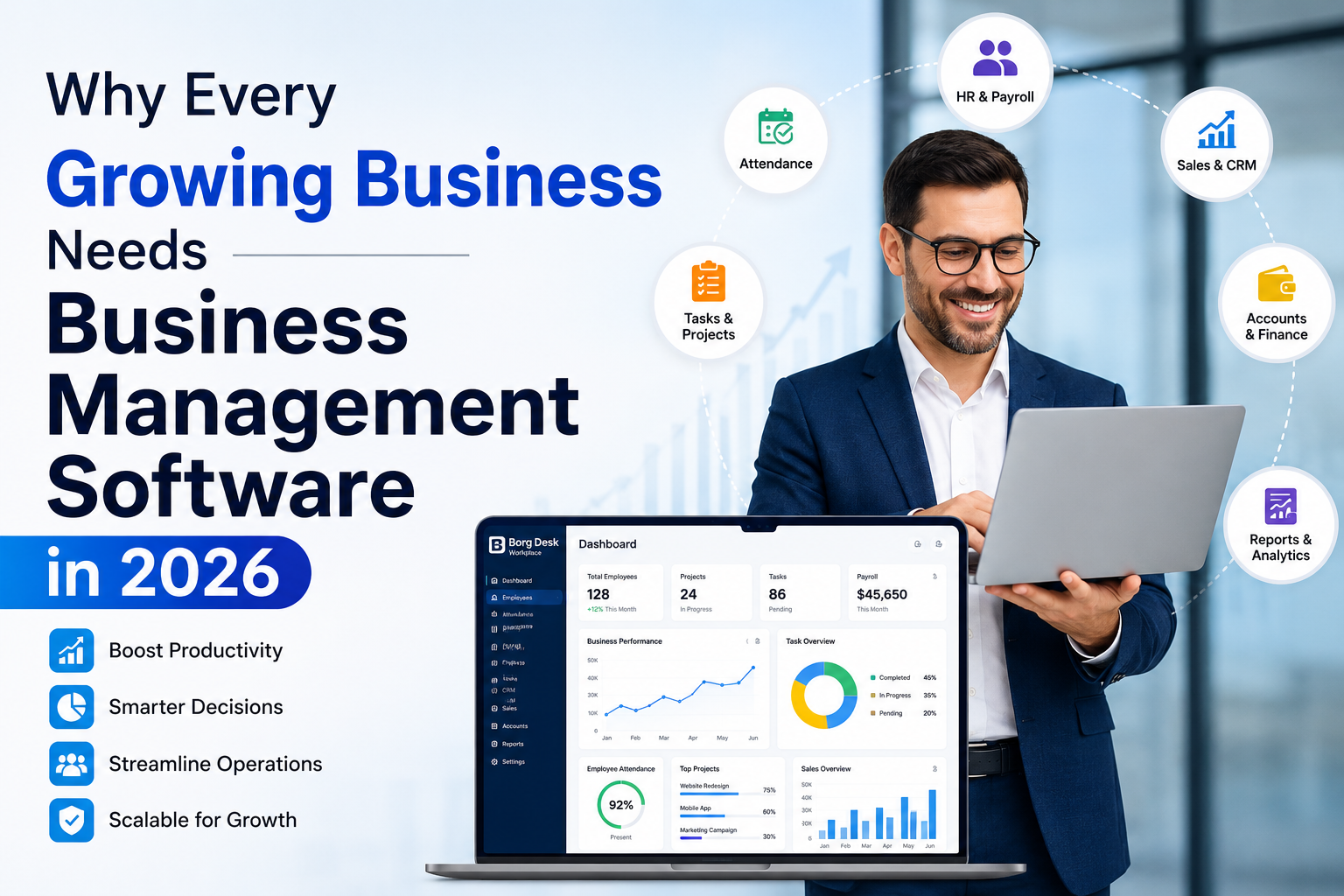
In today's fast-paced business environment, growth is both an opportunity and a challenge. As businesses expand, they often struggle with managing employees, tracking projects, handling customer relationships, processing payroll, monitoring finances, and maintaining operational efficiency. What worked for a small team using spreadsheets and manual processes quickly becomes inadequate as the organization grows.
In 2026, businesses are operating in a highly competitive, digital-first landscape where speed, accuracy, and data-driven decision-making are essential. To keep up with these demands, organizations are increasingly adopting Business Management Software to streamline operations and improve productivity.
Business Management Software has evolved from being a luxury for large enterprises to a necessity for businesses of all sizes. It integrates various business functions into a centralized platform, helping organizations automate processes, reduce manual work, and gain better control over their operations.
This article explores why every growing business needs Business Management Software in 2026 and how it can become a powerful tool for sustainable growth.
What Is Business Management Software?
Business Management Software is an integrated solution designed to manage and automate core business operations from a single platform. Instead of using separate tools for HR, payroll, attendance, project management, sales, customer relationship management (CRM), accounting, and reporting, businesses can manage everything in one centralized system.
Modern Business Management Software typically includes:
Employee Management
Attendance Tracking
Payroll Processing
HR Management
Project Management
Task Management
Sales and CRM
Accounting and Finance
Performance Monitoring
Reporting and Analytics
By connecting these functions, businesses can eliminate information silos and create a more efficient workflow across departments.
The Challenges Growing Businesses Face
Growth is exciting, but it often introduces operational complexity.These are some of the most common problems:
1. Managing Larger Teams
Tracking attendance, leaves, performance, and productivity gets more challenging when businesses expand their workforces. Manual techniques are ineffective and prone to errors.
2. Project Coordination
Managing multiple projects simultaneously requires proper planning, task allocation, and progress tracking. Without a centralized system, teams may miss deadlines and struggle with communication.
3. Data Fragmentation
A lot of businesses use different tools for different tasks.This creates disconnected data, making it difficult to gain a complete view of business performance.
4. Increased Administrative Work
Manual payroll processing, employee record management, and reporting consume valuable time that could be spent on strategic activities.
5. Lack of Real-Time Visibility
Decision-makers need access to accurate, real-time information. Delayed reports and outdated data can lead to poor business decisions.
Business Management Software addresses these challenges by centralizing operations and automating repetitive tasks.
Why Business Management Software Is Essential in 2026
1. Automation Saves Time and Reduces Errors
One of the biggest advantages of Business Management Software is automation.
Many companies continue to use manual procedures for:
Attendance tracking
Payroll calculations
Leave management
Task assignment
Invoice generation
Reporting
Manual processes increase the risk of errors and consume significant administrative time.
Automation ensures that routine tasks are completed accurately and consistently. This reduces human error, improves efficiency, and allows employees to focus on higher-value activities.
For growing businesses, automation can significantly reduce operational costs while increasing productivity.
2. Centralized Data Improves Decision-Making
Business leaders need accurate information in order to make smart choices.
Without a centralized system, data is often spread across:
Excel spreadsheets
Email threads
Accounting software
CRM platforms
HR systems
Gathering information from multiple sources can be time-consuming and unreliable.
Business Management Software provides a single source of truth where all business data is stored and updated in real time.
This enables management teams to:
Monitor business performance
Track employee productivity
Analyze sales trends
Evaluate project progress
Identify operational bottlenecks
Better visibility leads to better decisions and stronger business outcomes.
3. Enhanced Employee Productivity
Productivity is one of the main things that makes a business grow.
Business Management Software improves productivity by:
Assigning tasks efficiently
Tracking progress in real time
Automating repetitive work
Improving collaboration
Reducing administrative burdens
Employees spend less time searching for information and more time completing meaningful work.
Managers can also identify performance gaps and provide support where needed.
When teams have access to the right tools and information, they can work more efficiently and achieve better results.
4. Better Project Management
Managing projects becomes increasingly complex as businesses grow.
Missed deadlines, communication breakdowns, and unclear responsibilities can negatively impact project outcomes.
Modern Business Management Software includes project management features such as:
Task assignment
Deadline tracking
Progress monitoring
Team collaboration
Resource allocation
These features help businesses keep projects on track and within their budgets.
Project managers gain complete visibility into project status, enabling proactive decision-making and risk management.
5. Improved Customer Relationship Management
Customers expect faster responses, personalized experiences, and excellent service.
Business Management Software often includes CRM functionality that helps businesses:
Manage leads
Track customer interactions
Monitor sales pipelines
Automate follow-ups
Improve customer support
A centralized CRM system ensures that customer information is accessible across departments.
This leads to better communication, stronger relationships, and increased customer satisfaction.
Customers who are happy with your business are more likely to stick with it and tell others about it.
6. Streamlined HR and Payroll Operations
Human resource management becomes increasingly challenging as organizations expand.
Business management software makes HR tasks easier by automating:
Employee onboarding
Attendance tracking
Leave management
Payroll processing
Performance evaluations
Automated payroll reduces calculation errors and ensures employees are paid accurately and on time.
HR teams can focus on strategic initiatives such as employee engagement, training, and talent development instead of administrative tasks.
7. Real-Time Reporting and Analytics
Data-driven decision-making is a major competitive advantage in 2026.
Business Management Software provides powerful reporting and analytics tools that allow organizations to monitor key performance indicators (KPIs) in real time.
Businesses can track:
Revenue growth
Employee performance
Project profitability
Customer acquisition
Operational efficiency
Custom dashboards provide instant access to critical information.
Instead of waiting for monthly reports, leaders can make informed decisions based on real-time insights.
8. Scalability for Future Growth
One of the most important reasons to invest in Business Management Software is scalability.As businesses grow, their operational requirements become more complex.
A scalable system can support:
Additional employees
More projects
Increased customers
Expanded locations
New departments
Rather than replacing multiple systems as the business grows, organizations can continue using the same platform and add new functionalities as needed.
This ensures long-term operational stability and cost efficiency.
9. Improved Collaboration Across Teams
Modern businesses often have employees working from different locations.
Business Management Software provides a shared platform where teams can:
Access information
Collaborate on projects
Communicate effectively
Track responsibilities
This improves transparency and reduces misunderstandings.
Departments such as sales, HR, finance, and operations can work together more effectively because they are accessing the same information.
Stronger collaboration leads to faster execution and better business outcomes.
10. Competitive Advantage in a Digital Economy
Businesses that embrace digital transformation are better positioned to succeed.
Organizations that continue relying on manual processes may struggle to compete with more agile and technology-driven competitors.
Business Management Software enables businesses to:
Respond faster to market changes
Improve customer experiences
Increase operational efficiency
Reduce costs
Make smarter decisions
In an increasingly digital economy, technology is no longer optional—it is essential for survival and growth.
Key Features to Look for in Business Management Software
When evaluating a solution, businesses should look for the following features:
Employee Management
Manage employee records, attendance, leaves, and performance.
Payroll Automation
Automate salary calculations, deductions, and compliance requirements.
Project Management
Track projects, assign tasks, and monitor deadlines.
CRM Integration
Manage leads, customers, and sales opportunities.
Reporting and Analytics
Generate real-time reports and business insights.
Mobile Accessibility
Enable employees and managers to access information from anywhere.
Cloud-Based Infrastructure
Ensure flexibility, security, and scalability.
Workflow Automation
Automate repetitive business processes.
Choosing the right platform can significantly impact long-term business success.
The Future of Business Management Software
In 2026 and beyond, Business Management Software will continue to evolve with emerging technologies such as:
Artificial Intelligence (AI)
Machine Learning
Predictive Analytics
Business Intelligence
Workflow Automation
Cloud Computing
AI-powered systems can identify trends, predict outcomes, and recommend actions based on business data.
This allows businesses to become more proactive and strategic in their operations.
Organizations that adopt these technologies early will be better equipped to adapt to changing market conditions and drive sustainable growth.
Conclusion
Growth brings new opportunities, but it also introduces operational challenges that can limit business performance if not managed effectively.
Business Management Software helps growing businesses streamline operations, automate repetitive tasks, improve collaboration, enhance employee productivity, and make data-driven decisions.
In 2026, businesses need more than just software—they need a complete operational ecosystem that connects people, processes, and data in one place.
Whether you're managing employees, projects, payroll, sales, or customer relationships, Business Management Software provides the tools needed to operate efficiently and scale successfully.
Organizations that invest in the right solution today will be better prepared to compete, innovate, and grow in the future.
Transform Your Business with Borg Desk Workplace
Borg Desk Workplace helps businesses manage HR, Attendance, Payroll, Tasks, Projects, Sales, Accounts, and Employee Performance from a single centralized platform. Streamline operations, boost productivity, and accelerate business growth with smart business automation.






No comments found